When evaluating drowning-detection technology, the right question isn’t “which gadget looks fancier?” but “what does my pool really need?” Start by looking at the water. Can supervisors see all parts of the pool clearly? In practice, pool design often creates blind spots. Features or structures can obstruct lifeguards’ lines of sight, turning visibility into a critical safety issue. Any tech must address those visibility gaps.
Coverage
Does the system monitor every area, including underwater and shadowed corners?
Dependence on users
Does it rely on swimmers or parents to wear devices correctly?
Alert process
How precise is the alert? How quickly is it sent to staff?
Real-world testing
Has the system been proven under standards like ISO 20380 (the international drowning-detection benchmark)?
Operational fit
Is it suited to your setting: a crowded public pool, a swim school, a hotel pool or an outdoor resort?
Compliance and privacy
Are false alarms few, events logged, and privacy handled properly?
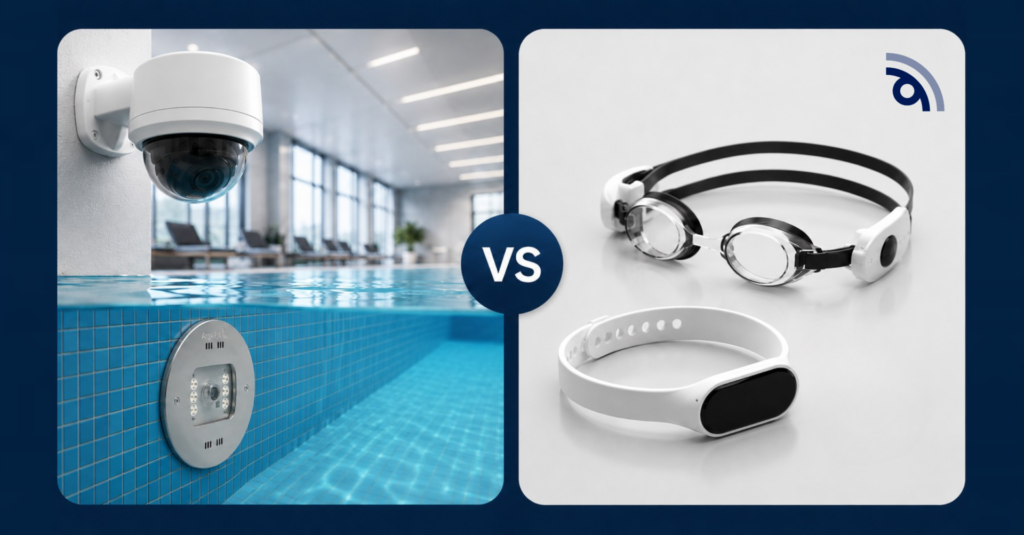
Wearable sensors (small headbands, wristbands or goggle clips worn by swimmers) offer a direct, swimmer-centric approach. They are usually inexpensive and easy to deploy: no cameras or construction needed. Basically, each swimmer dons a waterproof tracker that monitors how long they stay underwater. If a swimmer exceeds a preset submersion time, the device triggers an alarm or alert to lifeguards. The advantages are clear: wearables can work in anywater conditionand create “no blind spots” since they track each swimmer individually.
However, wearables also have important limitations. They depend on perfect user compliance: every swimmer must remember to wear and maintain the device. In a busy swim school or waterpark, trackers can easily slip off or be forgotten. Most swimmer-wearables do not provide real-time location data beyond “this person is underwater”. Critically, they only alert after the swimmer has been submerged for the set period (often 30 seconds or more). By then the emergency has begun. In short, wearables add safety but they also place a chunk of responsibility on the individual swimmer or their guardian.
Camera-based systems take the opposite approach: the technology lives in the facility, not on each person. Modern drowning-detection solutions typically use a combination of above-water and underwater cameras with real-time AI analysis. These systems can continuously track all swimmers without requiring them to carry devices. For example, ISO 20380‑compliant systems, like AngelEye, use smart cameras to spot the subtle signs of distress and send instant alerts. They can even pinpoint a swimmer’s location and provide lifeguards with a still image of the incident. Because they scan everywhere at once, cameras cover areas that a single lifeguard might miss. Unlike simple CCTV, they analyze motion patterns to distinguish normal swimming from a potential drowning.
The trade-offs are different. Camera systems usually cost more and require installation, but they can detect early indicators of trouble (like erratic movement) rather than just a timer-based trigger. They are also tested under standards like ISO 20380, which means independent labs verify their accuracy, speed and false-alarm rates. For example, AngelEye’s ISO‑accredited system is proven to “detect passive submerged bodies within the required timeframes” even under varying pool conditions. This gives operators confidence that the system will perform reliably, not just in demos but in real life.
In the end, neither wearables nor cameras alone is a magic bullet. Both are additional layers, not replacements for good supervision. The goal is to choose the right layer for your pool’s needs. If you manage a small learn-to-swim class, wearable trackers might suffice. In a large public facility with complex layouts, a camera system might provide more coverage. Above all, look past the marketing claims. Ask detailed questions: Does the camera see under water? Is there an ISO certificate? How does a wristband alert reach a lifeguard? How are false alarms handled?
Good pool safety is about fit, not flash. By focusing on standards and operational realities, operators can pick the clearest, most reliable support for lifeguards and swimmers alike, whether that means smart wearables, intelligent cameras, or both as part of a layered strategy.