From the detection requirements of ISO 20380 to the new scenarios addressed by ISO 20288: why understanding the current standard is essential when assessing the performance of drowning detection systems.
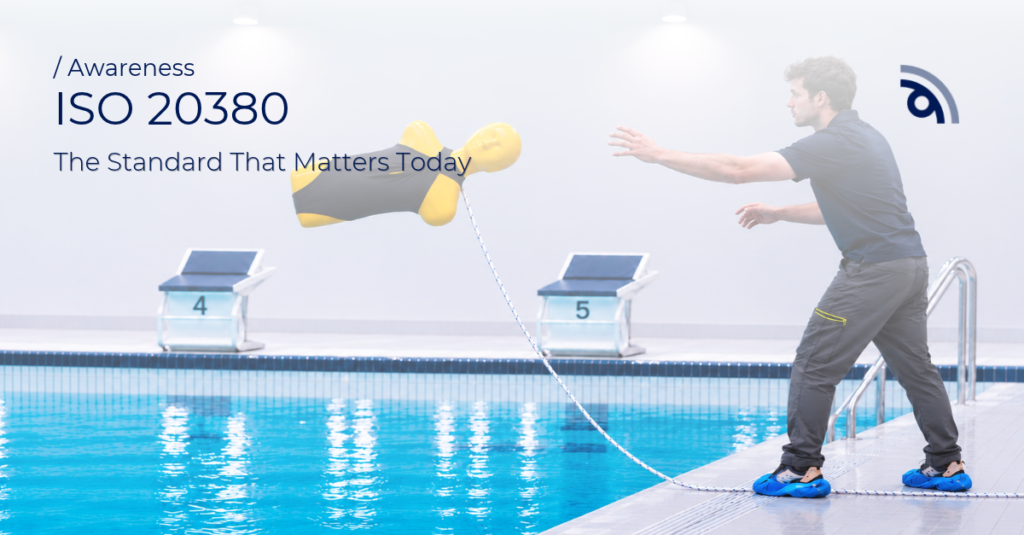
A test manikin is immersed in the pool, placed on the bottom and left motionless. This is the starting point for the detection test specified by ISO 20380, the only published international standard specifically addressing computer vision systems for drowning detection in public swimming pools. A stopwatch measures how long the system takes to trigger an alarm. With clearly defined requirements and measurable performance, this precise test method remains the established published reference in the field. The forthcoming ISO 20288 broadens the range of scenarios to be considered, but understanding what is changing begins with what ISO 20380 already establishes.
From system design to in-pool testing
First published in 2017 and reaffirmed in 2023, ISO 20380:2017 provides the international reference for this category of systems in the United States and Canada. It has been adopted nationally in the United Kingdom as BS EN ISO 20380:2017 and in Australia as AS ISO 20380:2022. The standard applies to swimming pools other than domestic pools, with a pool basin surface area of at least 150 m². Its value lies in the ability to verify performance directly at the facility where the system is installed.
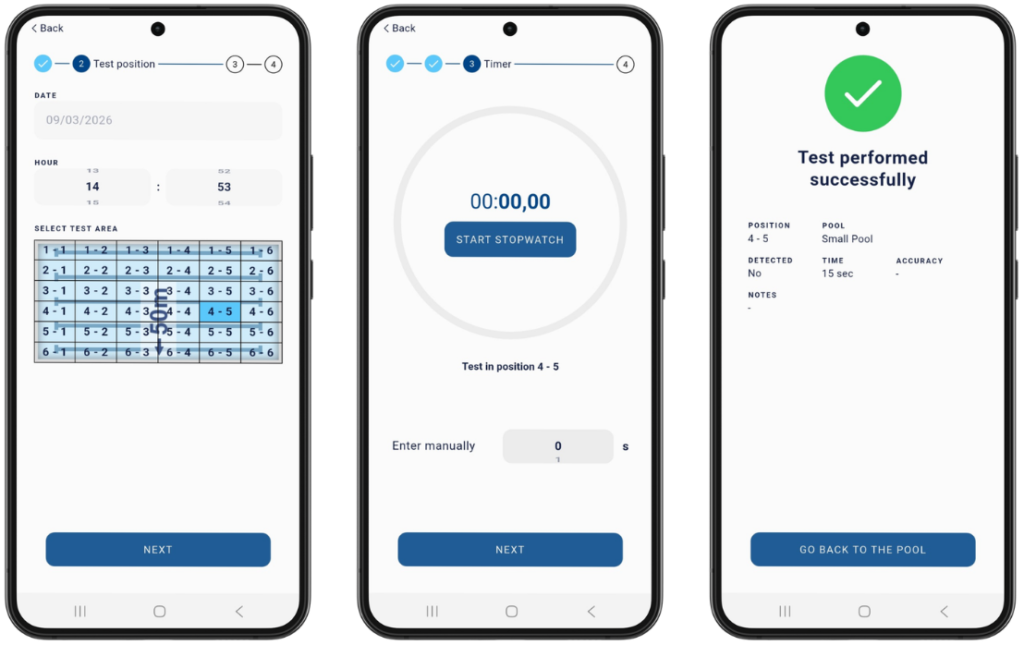
Before installation, a technical study defines the configuration of the video cameras and other devices, minimum lighting levels and coverage areas. The pool layout is then divided into a test grid, with points spaced approximately 4 metres along the length and 2 metres across the width. The manikin is immersed at these different points to verify the system’s detection capabilities throughout the areas identified as covered.
The test is passed if at least 80% of the trials conducted in the covered areas are successful. Uncovered areas are identified separately: the detection rate should not be confused with the percentage of the pool surface under surveillance.
When does a detection meet the standard’s requirements?
ISO 20380 defines the “alarm set-off time”, the time setting for triggering an alarm, which must be no greater than 15 seconds. During testing, a tolerance of ±2 seconds accounts for the lower precision of manual timing. With the alarm set to 15 seconds, a trial is successful if the alarm is triggered between 13 and 17 seconds after the manikin comes to rest on the pool bottom and the reported location is accurate to within 2 metres.
The repeatability of the tests also depends on the conditions under which they are conducted. The detection test is carried out with no swimmers in the monitored area, sufficiently clear water, exclusively artificial lighting that meets the levels defined in the technical study, and the processing unit disconnected from external networks. For pools with a movable floor, testing is repeated at two depths: the maximum depth and 1.5 metres.
The assessment also includes a non-detection test in areas up to 1.5 metres deep. A person stands motionless at five different locations for 35 to 40 seconds at each one. The system must not raise an alarm in more than two instances. The purpose is to establish whether the system can distinguish normal pool use from a situation that warrants an alarm.
Daily and six-monthly tests: ongoing performance verification
Commissioning is not the end of the testing required by the standard. ISO 20380 establishes two periodic testing procedures, carried out by trained staff, to ensure that system performance is maintained over time.
Daily test. Before the pool opens to the public, the manikin is immersed at a randomly selected point in the monitored pool, with the test location varying from day to day. Staff verify that an alarm is triggered, check the detection time and confirm the reported location.
Six-monthly test. Every six months, the full protocol is repeated, with tests performed at the grid points specified by the standard and the results documented. This verifies that performance is maintained across all areas identified as covered.
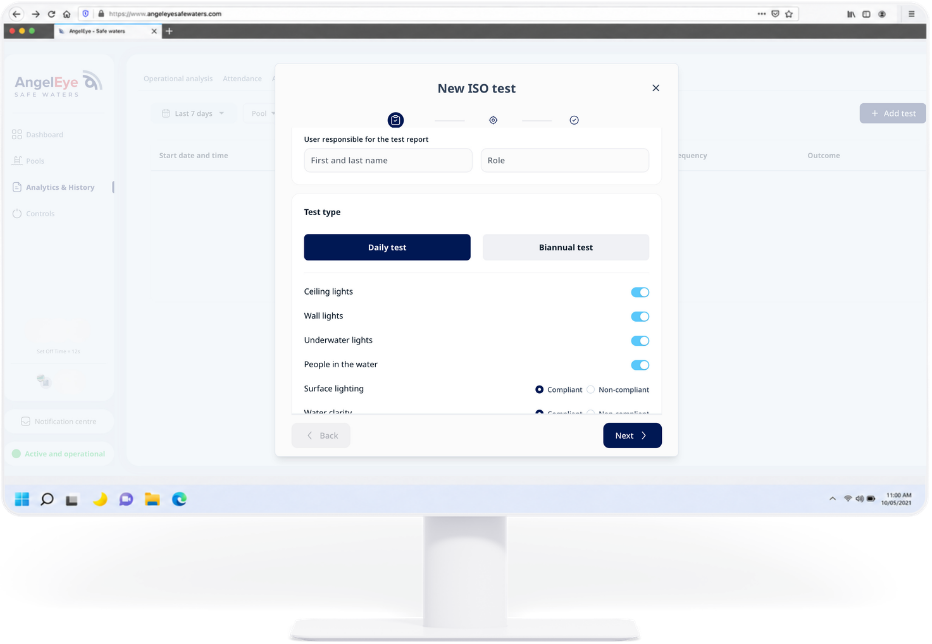
With AngelEye, both types of test can be logged through the desktop interface or the smartphone app. The operator selects the pool and immersion point, records the test conditions, detection time and outcome, and can add notes. The app guides the operator through each stage, from the stopwatch to signing the test report. The test history can be viewed by pool, date range, test type and outcome, providing a documented record of system performance over time.
What determines the effectiveness of a drowning detection system?
The quality of a system designed to detect potential drowning incidents is not measured in seconds alone. Effectiveness depends on the balance between four factors, each of which is essential to the day-to-day operation of an aquatic facility.
Reliability. Video cameras, processing units, software and alarm devices must operate as a single, integrated system. Equally important is ensuring that any faults or deterioration in performance are promptly reported to staff.
Detection rate. The ability to accurately identify a hazardous situation within the required time and with the required positional accuracy must be demonstrated through representative, repeatable tests in the pool concerned.
Operational continuity. AngelEye processes video footage locally, without relying on cloud services. Detection and alarm transmission over the local network remain operational even without an internet connection, provided the local infrastructure is functioning. ISO 20380 itself requires the detection test to be carried out without a connection to external networks.
Keeping false alarms to a minimum. A system that repeatedly draws staff attention to situations that pose no danger risks losing credibility. Initial configuration and optimisation may require fine-tuning, but a high rate of false alarms should never become the norm in everyday operation.
False alarms and trust in technology
Every alarm requires assessment by a lifeguard. When irrelevant notifications recur, alarm fatigue can set in: a gradual desensitisation to alerts that risks compromising the speed of response precisely when intervention is needed. This is why keeping false alarms to a minimum is just as important as detecting a hazardous situation.
ISO 20380 sets a maximum average of five false alarms per day per pool, calculated over 30 days of normal operation during public opening hours, excluding the special activities specified in the standard. The final draft of ISO 20288, which was still in the publication process as of 25 November 2026, instead specifies a limit of ten false alarms per day per pool, averaged over 30 days following commissioning.
The two documents address different scenarios and test methods, so comparing these thresholds alone is not a measure of system quality. It does, however, highlight a fundamental consideration for pool operators: what matters is not only what the technology can detect, but also how relevant the alerts delivered to staff are.
Investing in verifiable performance
When choosing a system to support swimming pool safety, the value of the technology depends on the rigour of the criteria used to assess it. ISO 20380 provides an established, published international benchmark with practical application in the field, allowing different solutions to be compared against common requirements and documented performance.AngelEye meets the requirements of ISO 20380 through site-specific system design, in-pool testing and tools for managing periodic tests. Until ISO 20288 is published, ISO 20380 remains the standard against which compliance of computer vision systems for drowning detection in public swimming pools should be assessed. Choosing a compliant solution means basing an investment not on a promise, but on measurable performance that can be verified over time.