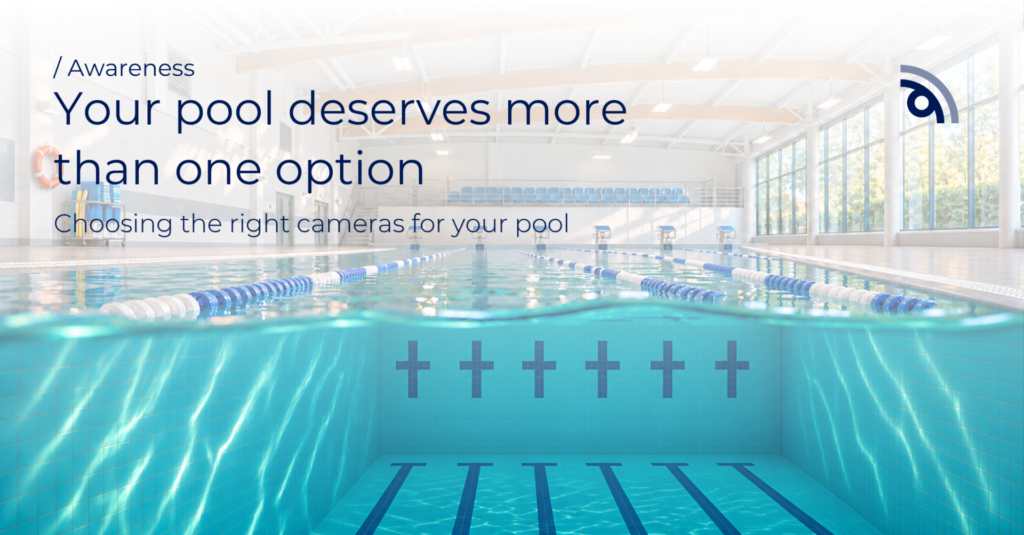
Overhead cameras can support effective drowning detection. Their suitability depends on how clearly swimmers can be seen when the pool is in use. Where the view from above is insufficient, underwater cameras should be considered.
The water surface can obstruct the view
A camera mounted above the pool looks through a constantly changing, reflective surface to capture what is happening underwater. Glare, ripples and swimmers obscuring one another can make parts of the pool harder to monitor. Windows, overhead structures and equipment used during activities also affect the view.
Careful design and multiple viewing angles can reduce these problems. Coverage still needs to be checked at relevant times of day and under representative operating conditions. A clear image of an empty pool does not, on its own, demonstrate adequate coverage when the pool is in use.
What underwater cameras add
An underwater camera observes what is happening below the waterline without having to look through the surface. This can provide a useful additional viewpoint where glare or the pool’s layout restricts the view from above. Underwater monitoring also requires sufficiently clear water, clean lenses and camera positioning that minimises obstructions.
Water depth is a key design parameter and, in some pools, may be the deciding factor when choosing overhead cameras, underwater cameras or a combination of the two. It should be assessed early in the design process, alongside the pool’s shape and visibility conditions.
Installation and the pool environment matter
Overhead cameras are often easier to install, both indoors and outdoors. They can be fitted to existing structures or mounted on dedicated poles. Where appearance is a priority, the visual impact of poles and visible equipment also needs to be considered as part of the architectural design.
In heated outdoor pools, cold winter air can cause mist to form above the water. Dense mist can severely restrict the view from above, making images unusable for detection.
For new pools, underwater cameras can be planned from the outset and built into the pool structure. AngelEye cameras with integrated LED lighting also combine underwater imaging and pool lighting in a single unit.
Suitability must be verified on site
AngelEye can use overhead cameras, underwater cameras or a combination of both, depending on the facility. The configuration is based on an assessment of the site and verified during commissioning.
Before accepting a proposal, ask which areas will be monitored, what conditions could restrict visibility and how detection will be tested. Camera numbers alone do not answer these questions. A system using only overhead cameras is appropriate when the design assessment and testing demonstrate that it is suitable for the pool.